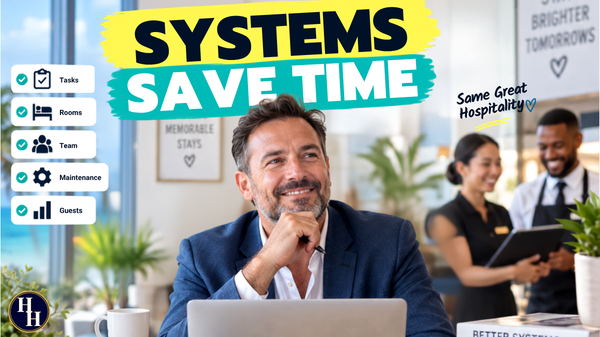
Better hotel operations management can save independent hotel owners hours of repeated work without sacrificing the personal hospitality guests remember.
The right hotel operations systems reduce interruptions, improve staff communication, and give you more time to look after guests instead of constantly chasing information.
.
Your Hotel Shouldn’t Need You for Everything
Ever feel as though your hotel can run perfectly well without you, right up until you try to leave the room?
Suddenly, everybody needs you.
Housekeeping wants to know whether room 108 has checked out.
Reception wants to know whether room 204 is ready.
Someone can’t find the maintenance request.
A supplier has called.
A guest needs something.
And somewhere in the building, a toilet has chosen this exact moment to express itself.
That’s independent hotel ownership.
You start the day intending to manage the business.
By 10:30, the business is managing you.
And here’s the twist.
The problem may not be that you have too much work.
The problem may be that too much ordinary work still has to pass through you.
In this post, I’m going to show you how simple hotel operations systems can save time without making your hotel feel cold, automated, or corporate.
Because the goal isn’t to remove hospitality.
It’s to remove unnecessary work from hospitality.
.
Hi, I’m Gerry MacPherson.
I’ve spent decades in hospitality, tourism, and hotel operations, and I’ve seen the same problem appear in properties of every shape and size.
Good owners care.
So they get involved.
Then they get involved in everything.
Before long, they’re the manager, problem solver, walking operations manual, and emergency contact rolled into one.
I help independent hoteliers build stronger operations, improve bookings, and reduce that daily stress.
So let’s make your hotel a little less dependent on what’s stored inside your head.
.
Over the next few minutes, we’ll look at three things.
First, how to spot the repeated work that’s quietly stealing your time.
Second, which hotel tasks you can systemise or automate without damaging hospitality.
And third, how one simple Daily Operations Dashboard can help you see what needs attention without chasing people around the property.
By the end, you’ll have a practical place to start.
Not twenty new systems.
One better one.
.
Stop Losing Your Day Ten Minutes at a Time
Here’s where many hotel owners get stuck.
You rarely lose an entire day to one enormous disaster.
You lose it in pieces.
Five minutes answering a question.
Eight minutes finding information.
Ten minutes checking whether somebody finished something.
Another five minutes explaining a process you’ve explained before.
Then somebody asks about tomorrow’s arrivals.
Then housekeeping needs you.
Then the phone rings.
By lunchtime, your working day looks as if somebody fed it through a paper shredder.
And it makes sense.
Independent hotels often grow organically.
You add a process because you need one.
Then another.
Someone starts using a spreadsheet.
Someone else starts a WhatsApp group.
Reception keeps notes beside the computer.
Maintenance has another list.
And you remember the rest.
That’s where the friction begins.
So here’s your first fix.
For one week, keep an interruption log.
Nothing complicated.
Every time somebody interrupts you with an operational question, write it down.
Is room 12 ready?
Did maintenance fix the shower?
What time is the Smith booking arriving?
Who approved the late checkout?
Don’t judge the questions.
Look for repetition.
Because if your staff keep asking you the same question, you may not have a staff problem.
You may have a system problem.
Small change.
Big difference.
.
Don’t Turn Your Memory Into Hotel Software
Here’s the second problem.
Hotel owners develop remarkable memories.
You know Mrs Thompson prefers the quiet room.
You know room 16 has a window that needs an extra push.
You know the boiler service is due next month.
You know which supplier delivers on Tuesdays.
You know which staff member can cover breakfast if someone calls in sick.
Useful?
Absolutely.
Scalable?
Not remotely.
The moment important operational knowledge lives only in your head, the hotel needs access to your head to function.
That’s why SOPs, shared information, task ownership, and a good property management system matter.
A written process isn’t bureaucracy.
It’s memory with a backup.
Your PMS should hold the core information people need.
Your SOP should explain repeatable tasks.
Your task system should show who owns a job.
And staff should know where to look before they have to ask you.
You don’t need a 300-page manual that requires its own luggage trolley.
Start with the questions people ask most often.
Document those processes first.
That’s where you’ll usually find your fastest time savings.
.
Automate the Work, Not the Welcome
Now we reach the part that makes some independent hotel owners nervous.
Automation.
I understand why.
The word can conjure up images of guests wandering around your lobby looking for a human while a screen cheerfully tells them how valued they are.
That’s not what I’m suggesting.
The rule is simple.
Automate the predictable. Systemise the repeatable. Humanise the memorable.
A booking confirmation?
Automate it.
Pre-arrival information?
Automate it.
A routine checkout message?
Automate it.
Updating room status?
Systemise it.
Assigning a maintenance job?
Systemise it.
But a nervous guest arriving alone late at night?
Human.
A couple celebrating their anniversary?
Human.
An upset guest whose stay has gone wrong?
Very human.
Imagine complaining about your anniversary stay and receiving:
“Your request number 4837 has been received.”
Nothing says romance like ticket number 4837.
The closer a guest moment is to emotion, the more careful you should be with automation.
Technology should make your hotel feel more attentive.
Not more technological.
The system handles repetition.
Your people handle meaning.
.
Put Housekeeping, Maintenance and Tasks Where Everyone Can See Them
Now let’s deal with three enormous sources of wasted time.
Housekeeping.
Maintenance.
And task ownership.
Housekeeping shouldn’t need to hunt down reception to discover which rooms have departed.
Reception shouldn’t need to hunt down housekeeping to discover which rooms are ready.
And you certainly shouldn’t have to stand between them translating messages.
A shared room-status system solves that.
One source.
One status.
Everybody sees the same information.
Maintenance needs the same discipline.
Every maintenance issue should answer four questions:
What’s wrong?
How urgent is it?
Who owns it?
Has it been completed?
Because if maintenance jobs arrive through WhatsApp, email, Post-it notes, verbal messages, and someone shouting across the breakfast room, you don’t have a maintenance system.
You have a treasure hunt.
And finally, every important task needs an owner.
A task without an owner becomes everybody’s responsibility.
Everybody’s responsibility eventually becomes nobody’s responsibility.
And then it becomes yours.
Give the job a name.
Give it a deadline.
Define what finished means.
Now your staff can act instead of waiting for you.
.
What’s the repeated operational question you hear most often in your hotel?
Maybe it’s room status.
Maintenance.
Guest requests.
Staff rotas.
Late checkouts.
Whatever it is, let me know in the comments.
I read them, and your answer may help another hotel owner recognise the same problem in their property.
.
Build a Dashboard That Shows What Needs Attention
Now let’s bring everything together.
You need visibility.
But visibility doesn’t mean 47 reports and a spreadsheet that looks as though it was designed by NASA.
You need to know what matters today.
That’s what your Daily Operations Dashboard is for.
Think about your car.
Your dashboard doesn’t show you every mechanical process happening underneath the bonnet.
You don’t get a live piston feed.
You get the information you need to drive.
Speed.
Fuel.
Warnings.
Your hotel dashboard should work the same way.
At a glance, you should be able to see:
Today’s occupancy.
Arrivals and departures.
Rooms that aren’t ready.
Maintenance issues.
Guest concerns requiring follow-up.
Staffing gaps.
And today’s three main priorities.
Three.
Not seventeen.
If everything is urgent, nothing is.
This week’s signature deliverable is the Daily Operations Dashboard, and it’s available for download in the show notes.
Use it for a ten-minute daily team huddle.
Ask four questions.
What happened overnight?
What’s happening today?
What might go wrong?
Who owns each action?
That’s it.
Ten minutes now can prevent dozens of interruptions later.
More importantly, something begins to change.
Your staff stop waiting for you.
They can see what’s happening.
They know what matters.
They know what they own.
They make more decisions themselves.
That’s not losing control.
That’s gaining it.
.
Start by Buying Back 30 Minutes
Don’t finish this post and decide you’re going to automate your entire hotel by Friday.
You’ll frighten yourself, your staff, and possibly the Wi-Fi.
Start smaller.
Pick one repeated task.
Something that takes ten minutes and happens several times each week.
Then ask yourself:
Can I eliminate a step?
Can I create a template?
Can I delegate this?
Can my PMS automate it?
Can my staff find the answer without asking me?
Fix that one process.
Run it for a week.
See what happens.
Your first goal isn’t to save ten hours.
Save thirty minutes.
Then save another thirty.
That’s how systems give you control.
Not through one enormous transformation.
Through dozens of small jobs that no longer need you standing beside them.
.
A Couple of Resources to Help You Do It
If today’s conversation has made you think, “I can already see three things we’re doing the hard way,” start with the free Your Independent Hotel Blueprint.
It gives you the wider framework for looking at your independent hotel, so you can see where your operations, guest experience, marketing, and management foundations need attention.
Then download this week’s Daily Operations Dashboard from the show notes.
Use the Blueprint to see the bigger picture.
Use the dashboard to control today.
And if you’d like to go deeper into creating calmer operations, I’ve also included my From Chaos to Control: The 3 Fixes Every Hotel Owner Needs to Boost Bookings and Cut Stress webinar in the notes.
No need to change everything at once.
Start with the process that keeps interrupting you.
.
Here Are Your Key Takeaways
- Automate predictable work
- Systemise repeated tasks
- Keep emotional moments human
- Make daily priorities visible
- Systems should free your people
.
In Conclusion
Good hotel operations management isn’t about squeezing more work into your day.
It’s about removing work that shouldn’t need your attention in the first place.
The right systems give your team clearer information, clearer ownership, and more confidence to act.
And that gives you something every independent hotel owner could use more of.
Time.
Time to speak with guests.
Time to lead your staff.
Time to improve the business.
And perhaps, occasionally, time to finish a cup of coffee while it’s still hot.
The Daily Operations Dashboard is available in the show notes, along with the free Your Independent Hotel Blueprint.
Remember:
Automate the predictable. Systemise the repeatable. Humanise the memorable.
That’s how you save time without losing hospitality.
Next Episode, We’ll Talk About Pricing With Confidence
Next week, October 19 to October 25, we’ll move into Pricing with Confidence.
We’ll answer the cornerstone question:
How do I know if my prices are too high, too low, or just right?
And the week’s signature deliverable will be the Pricing Confidence Worksheet.
Because once you’ve created more control over your operations, the next question is whether every room you’re selling is earning what it should.
If you are interested in more resources to help grow your business, visit HotelierHelpcast.com.