
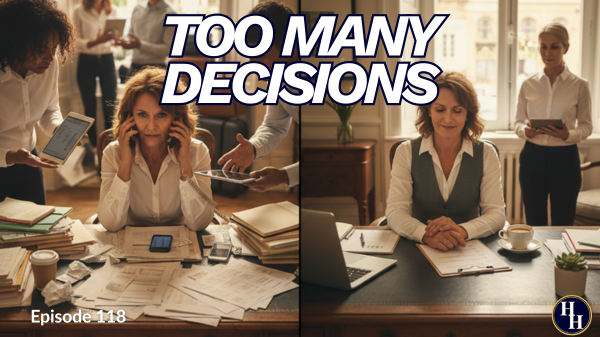

- Running an independent hotel means making hundreds of small decisions every day, yet many owners never realise how these choices slowly drain their time, energy, and profits.This episode shows hotel owners how decision fatigue creeps into daily operations and how recognising these hidden decisions can restore focus, calm, and better results.
- How Hidden Daily Decisions Quietly Drain Independent Hotel Owners-118
- How Can Hotel Owners Think Long-Term Instead of Chasing Daily Bookings?-117
- How Can a Hotel Benefit from HR Software?-116
Running an independent hotel means making hundreds of small decisions every day, yet many owners never realise how these choices slowly drain their time, energy, and profits.
This episode shows hotel owners how decision fatigue creeps into daily operations and how recognising these hidden decisions can restore focus, calm, and better results.
The Hidden Weight Hotel Owners Carry
If you own an independent hotel, your day rarely starts gently.
The alarm goes off early. Coffee comes first. Then your brain starts racing.
Did housekeeping finish the deep clean in room twelve?
Did the supplier confirm the breakfast delivery?
Why did last night’s online review mention slow check-in?
Before your feet even hit the floor, you have already started making decisions.
And here is the strange thing about running a hotel. Most owners believe the hardest part is attracting guests.
But often the real challenge is something else entirely.
It is the endless stream of decisions.
Small decisions. Medium ones. Occasionally big ones. But mostly small ones.
And they arrive all day long.
Should we upgrade the breakfast menu?
Should we respond publicly to that review?
Should we replace the mattress in room seven or wait another season?
None of these decisions look dramatic. None of them appear dangerous.
But together they pile up.
And over time they drain you.
Welcome to another episode of the Hotelier Helpcast podcast.
If you haven’t done so yet, sign up and ring the bell so you don’t miss future episodes.
Because the truth is this.
Most independent hotel owners are not exhausted because they are doing the wrong things.
They are exhausted because they are making too many decisions.
Every day.
Without systems.
Without clarity.
Without breathing room.
And if you recognise yourself in that description, relax. You are not doing anything wrong.
In fact, what you are experiencing is extremely common.
Running an independent hotel means juggling guest service, marketing, maintenance, staffing, finances, and reputation management all at the same time. According to hospitality research, independent properties often operate with smaller teams and fewer structured processes than large hotel chains. That means the owner becomes the final decision-maker for nearly everything.
Which sounds empowering at first.
Until it becomes exhausting.
Later in this episode I am going to share one surprising insight that helps many hotel owners reclaim several hours each week. It is simple. Almost boring. Yet when implemented correctly, it changes everything.
But before we get there, we need to recognise the real problem.
And if you want deeper insights like this, you will find more inside the “Your Independent Hotel Blueprint” guide, which expands on many of these ideas and practical strategies for independent hoteliers.
Let me ask you a question.
When was the last day you ran your hotel without feeling mentally overloaded by decisions?
Take a moment to think about that.
Because recognising the problem is where change begins.
.
.
Death by a Thousand Tiny Decisions
Let’s talk about something most hotel owners rarely discuss.
Decision fatigue.
It sounds like a term from a psychology textbook. But if you run a hotel, you experience it daily.
Picture this.
A guest complains the shower pressure is weak.
A staff member calls in sick.
Breakfast supplies arrive late.
An OTA promotion email suggests lowering your room rate.
Each situation demands a decision.
None are life-threatening.
But each one pulls a little bit of mental energy from you.
And by the end of the day your brain feels like an overworked front desk clerk during a sold-out festival weekend.
Researchers studying decision fatigue have shown something interesting. The more decisions a person makes throughout the day, the harder it becomes to make good ones later.
Think of your mental energy like a mobile phone battery.
Every decision drains a few percent.
Answering emails drains a little.
Solving staff issues drains a bit more.
Handling guest complaints drains even more.
Eventually the battery runs low.
And when that happens, people do one of three things.
They delay decisions.
They make poor choices.
Or they default to the easiest option.
Now think about what that means inside a hotel.
Delaying decisions might mean postponing maintenance issues.
Choosing the easiest option might mean lowering room rates instead of improving marketing.
Making poor decisions might mean hiring too quickly or reacting emotionally to guest reviews.
None of this happens because hotel owners are careless.
It happens because their decision battery is empty.
And independent hotel owners face an extra challenge.
Large hotel chains run on systems.
Standard procedures. Checklists. Brand guidelines.
Independent hotels often rely on instinct instead.
Now instinct can be powerful. Many successful properties were built on passion, personality, and personal service.
But instinct alone has a limit.
Imagine trying to drive across Europe without a map, GPS, or road signs. You might reach your destination eventually, but the journey will feel chaotic.
That is how many hotel owners run their businesses.
Every day becomes a reaction.
Something breaks.
A guest complains.
A marketing idea appears.
And suddenly another decision arrives.
Let me share a quick story.
A hotel owner I once spoke with described his daily routine like this.
“Every morning I sit down to work on strategy. Every afternoon I realise I spent the whole day putting out fires.”
Sound familiar?
Most independent hoteliers start their business because they love hospitality.
They enjoy welcoming guests. Creating memorable stays. Building something special.
But gradually the job changes.
Instead of creating experiences, they spend most of their time managing decisions.
Pricing decisions.
Staff decisions.
Supplier decisions.
Technology decisions.
Even tiny details.
What music should play in the lobby?
What time should breakfast close on Sundays?
Should we repaint the hallway this year?
Individually these decisions seem trivial.
Collectively they become overwhelming.
And the cruel irony is this.
Many hotel owners believe this chaos simply comes with the territory.
They assume running a hotel must always feel like this.
But it doesn’t.
Later in this episode we will explore how recognising these hidden decisions is the first step toward reclaiming your energy and confidence as a hotel owner.
Because once you see them clearly, something remarkable happens.
You realise many of those decisions should never have reached your desk in the first place.
.
.
The Invisible Decision Traps
Now that we’ve named the problem, let’s slow down and examine something important.
Most hotel owners don’t realise where their decision fatigue actually comes from.
It’s rarely the big decisions.
Choosing a renovation budget.
Hiring a general manager.
Investing in new booking software.
Those are obvious.
You expect them.
The real drain comes from small, repeating decisions that should already have answers.
Think about your typical morning.
You arrive at the hotel. The day begins.
Immediately, questions appear.
“Should we comp this guest’s breakfast?”
“Should housekeeping prioritise early check-ins today?”
“Should we upgrade this returning guest?”
These questions seem harmless. Even normal.
But here’s the important insight.
When a decision repeats frequently, it should eventually become a system.
Without that shift, the same questions return every day.
And every time they return, they drain energy.
Let’s look at a few common traps where independent hotel owners lose time and mental focus.
.
Trap One: Operational Micro-Decisions
Hotels run on hundreds of tiny operational choices.
What time should housekeeping start cleaning vacant rooms?
Should late check-out cost extra today?
Should staff offer a complimentary drink after a complaint?
Without guidelines, every situation becomes a conversation.
The front desk calls you.
Housekeeping checks with you.
Your staff wait for instructions.
Soon the hotel becomes dependent on your availability.
And that’s where exhaustion begins.
In large hotel brands, most of these decisions already have written procedures.
But independent hotels often skip this step because writing procedures sounds dull.
Yet those procedures quietly protect your time.
Hotels thrive when daily actions follow clear systems rather than constant improvisation.
In other words, great hospitality can still be organised.
And organised hospitality feels calmer.
.
Trap Two: Pricing Guesswork
Pricing decisions create another invisible drain.
Many hotel owners adjust room rates constantly.
Sometimes daily. Sometimes hourly.
A competitor drops their price.
An OTA sends a promotional alert.
Suddenly you wonder.
“Should we lower our rates too?”
The problem is not adjusting prices.
Revenue management matters.
The problem is making pricing decisions without a consistent strategy.
Without guidelines, each pricing change becomes a stressful choice.
Should we discount?
Should we hold firm?
Should we run a promotion?
This mental loop drains focus.
Instead, successful hoteliers often establish pricing rules.
For example:
Occupancy below 40 percent triggers promotional rates.
Occupancy above 80 percent triggers higher pricing tiers.
The rule removes the emotional guesswork.
And suddenly dozens of decisions disappear.
.
Trap Three: Technology Overload
Modern hospitality technology promises efficiency.
But many hotel owners feel the opposite.
Channel managers.
Booking engines.
Property management systems.
Guest messaging apps.
Every tool claims to simplify your work.
Yet many properties operate with several systems that don’t communicate well.
Which leads to more decisions.
Should we upgrade the software?
Should we replace the booking engine?
Should we add another tool?
Technology should simplify operations, not multiply decisions.
And often the best approach is surprisingly simple.
Choose fewer tools.
Use them well.
.
Trap Four: Staff Dependence
Another decision trap appears inside the team.
Many independent hotel owners build strong personal relationships with their staff.
Which is wonderful.
But sometimes it creates dependency.
Every question comes directly to the owner.
Every unusual guest request waits for approval.
And soon the owner becomes the centre of every decision.
This might feel like good leadership.
But it quietly limits your hotel’s growth.
A strong team should be able to make many decisions independently.
Not because they are reckless.
But because they understand clear boundaries.
Inside the Your Independent Hotel Blueprint, one of the foundational ideas is creating clarity so staff can act confidently without constant oversight.
When employees know what good service looks like, they stop asking permission for every situation.
And the owner finally breathes.
.
Trap Five: Marketing Distractions
Marketing creates another quiet drain.
Should we post on Instagram today?
Should we try TikTok?
Should we start a newsletter?
Should we run a giveaway?
Marketing ideas appear constantly.
And many owners chase them one by one.
But without a strategy, each idea becomes another decision.
Should we try this?
Should we stop that?
Should we switch again?
Instead of building momentum, the hotel keeps restarting.
A consistent marketing plan removes this confusion.
You know what to post.
You know when to promote.
You know what success looks like.
Which means fewer daily decisions.
.
.
A Simple Pattern
Notice something interesting about all these traps.
Operational decisions.
Pricing choices.
Technology questions.
Staff approvals.
Marketing experiments.
They share one thing.
They repeat.
And whenever a decision repeats frequently, it becomes a candidate for a system.
Systems remove uncertainty.
Systems remove stress.
Systems quietly give your mind space again.
And that leads us to an important shift in perspective.
.
.
You’re Not Bad at Running a Hotel
Let’s address something honestly.
Many independent hotel owners secretly believe they are the problem.
They assume they should be more organised.
More disciplined.
More efficient.
They look at large hotel chains and think:
“Maybe I’m just not good at this.”
But here’s the truth.
You are not struggling because you lack ability. You are struggling because independent hospitality often lacks structure.
Large hotel brands operate with detailed systems for nearly everything.
Check-in procedures.
Complaint handling.
Pricing adjustments.
Housekeeping schedules.
Even how staff greet guests.
Independent hotels often skip this structure in the beginning.
And that makes sense.
Many hotels start as passion projects.
A family property.
A boutique concept.
A dream.
At the beginning, systems feel unnecessary.
You know every room.
You greet every guest personally.
You make decisions instinctively, but as the hotel grows, something changes.
More guests arrive.
More staff join.
More bookings appear online and suddenly instinct alone isn’t enough.
Without systems, the owner becomes the bottleneck not because they want control, but because nobody else has the answers.
Think of it like building a restaurant kitchen.
At first, the chef cooks every dish but if the restaurant becomes popular, the chef must train a team. Otherwise service collapses.
The same principle applies to hotel management.
Systems are not about removing personality.
They protect it.
When routine decisions run smoothly, you gain time to focus on what truly matters.
Guest experience.
Team culture.
Strategic growth.
Inside the Hotel Owner’s Roadmap: 90 Days to More Bookings, More Time, and Less Stress, this shift forms the backbone of the program.
The goal is not to make hotel owners work harder.
The goal is to help them install systems that reduce unnecessary decisions and restore focus because running a hotel should feel demanding, yes. But not chaotic.
.
.
The Myth of the “Always Busy” Hotel Owner
Hospitality culture often glorifies busyness.
If you ask hotel owners how things are going, you often hear the same answer.
“Busy.”
It almost sounds like a badge of honour.
But constant busyness is not always a good sign.
Sometimes it means the hotel lacks clear systems.
Think about airline pilots.
A passenger might assume pilots constantly make complex decisions during flight.
But most flights follow structured procedures.
Checklists.
Standard communication.
Automated systems.
Because aviation learned something important decades ago.
Humans make better decisions when routine tasks follow systems.
Hotels are no different.
When routine decisions become automated through processes, the owner gains something priceless.
Mental clarity.
.
.
The Emotional Shift
Here is the surprising result when hotel owners reduce daily decisions.
Stress decreases.
Confidence increases and creativity returns. Suddenly the owner starts thinking strategically again.
How can we improve the guest experience?
What partnerships could attract new travellers?
How can our property stand out?
Those ideas rarely appear when your brain is busy deciding which room should receive extra towels and this is why recognising decision fatigue matters.
Not just for productivity, but for your enjoyment of the business.
Many independent hoteliers entered the industry because they loved hospitality.
Yet somewhere along the way, the joy faded.
The constant decisions buried it but the joy returns when systems lighten the load because hospitality becomes creative again.
You start designing experiences rather than reacting to problems and that shift feels powerful.
.
.
A Moment of Relief
So if you are feeling overwhelmed right now, take a breath.
Your exhaustion does not mean you are failing. It means you have been carrying too many decisions.
And the good news?
Decisions can be organised.
Simplified.
Shared.
You don’t need to solve everything overnight but recognising the problem changes how you see your work.
Instead of asking,
“Why can’t I keep up?”
You begin asking,
“Which decisions shouldn’t reach me anymore?”
That single question changes everything.
.
.
One Practical Shift That Reduces Daily Decisions
Let’s move from recognition to something useful because awareness alone doesn’t lighten your workload.
Action does.
The most powerful shift many independent hotel owners make is surprisingly simple.
They stop treating recurring decisions as decisions.
Instead, they turn them into default rules.
Not complicated systems. Not heavy manuals.
Just clear rules for common situations.
Let me show you how this works.
Imagine a guest requests a late checkout. In many independent hotels the front desk immediately asks the owner.
“Should we allow it?”
The owner checks occupancy. Thinks about housekeeping schedules. Responds with an answer.
This happens several times every week.
Now imagine a simple rule.
Late checkout is free until noon if occupancy is below 70 percent. After noon it costs $20.
Suddenly the decision disappears.
Staff know the answer. Guests receive faster service. The owner stays focused on bigger priorities.
That’s the power of default rules.
.
.
Start With the Most Frequent Questions
You don’t need to redesign your entire operation. Start with one observation exercise.
For the next week, write down every question your team asks you.
You might notice patterns quickly.
Questions about:
- early check-in
- late check-out
- room upgrades
- small guest complaints
- minor maintenance approvals
If a question appears more than twice, it deserves a guideline.
The rule doesn’t need to be perfect, it only needs to reduce repeated decisions.
Over time your hotel begins to operate more smoothly, not because you removed flexibility but because you removed confusion.
.
.
Empower Your Team
Default rules also help staff feel confident.
Nothing frustrates employees more than uncertainty. They want to deliver good service but they hesitate if every action requires permission.
Clear guidelines solve this.
For example.
If a guest complaint costs less than $30 to resolve, staff may solve it immediately.
Complimentary dessert.
Free drink.
Small gift.
Suddenly problems disappear faster.
Guests feel cared for and the owner stops managing every detail.
Inside hospitality training programs, this principle appears repeatedly.
Empowered teams deliver stronger service because they act quickly and quick service often turns complaints into memorable experiences.
.
.
Systems Protect Your Energy
One of the most overlooked benefits of systems is emotional.
They protect your energy.
Think about how much time hotel owners spend thinking about problems even after the workday ends.
While cooking dinner.
While driving home.
Even while lying in bed.
Should we change our breakfast supplier?
Should we redesign the website?
Should we increase staff training?
Systems reduce that mental noise because decisions already have a direction and when your mind feels calmer, leadership becomes easier.
You start thinking strategically again and strategy is where long-term success lives.
.
.
A Quiet but Powerful Habit
If you remember only one idea from this episode, let it be this.
Whenever a decision repeats, create a rule.
Write it down.
Share it with your team.
Then move forward.
Over time, your hotel develops its own operating rhythm.
Guests experience smoother service.
Staff feel confident.
And the owner regains something precious.
Mental space.
Which is exactly what most independent hoteliers are missing.
.
 .
.
Still winging it with spreadsheets and second guesses?
There’s a better way.
“Your Independent Hotel Blueprint” download lays it all out. Seven clear steps from dream to done.
Grab it now. Free. Field-tested. Owner-approved.
You can find the link in the show notes.
.
What is one small decision in your hotel that keeps coming back every week?
Write it in the comments.
.
Here Are Your Key Takeaways
- Small decisions quietly drain energy
- Repeating choices should become rules
- Systems create calm operations
- Staff need clarity, not constant approval
- Simplicity restores focus
.
In Conclusion
Running an independent hotel often feels like juggling a dozen spinning plates.
Guests arrive with expectations.
Staff need direction.
Suppliers need decisions.
Marketing demands attention and in the middle of all that activity stands the owner trying to keep everything moving.
The hidden challenge isn’t the workload itself. It’s the endless stream of decisions.
Each question. Each approval. Each tiny operational choice quietly consumes mental energy.
Individually they seem harmless. Together they create exhaustion.
But once you recognise the pattern, something powerful happens.
You realise that many of those decisions were never meant to stay decisions forever.
They were simply waiting to become systems.
When a repeated decision becomes a rule, the pressure lifts.
Staff act confidently.
Guests receive quicker service and the owner finally regains mental breathing room.
That breathing room matters because the real role of a hotel owner isn’t to answer every operational question.
It’s to shape the experience.
To guide the culture.
To grow the business thoughtfully.
That becomes possible only when daily decisions stop overwhelming the mind.
If you want to explore these ideas further, you’ll find a downloadable resource linked in the notes for this episode. It expands on several of the operational principles we discussed today.
And if you want deeper guidance on installing systems that increase bookings, free up time, and reduce stress, you’ll find structured support inside “The Hotel Owner’s Roadmap: 90 Days to More Bookings, More Time, and Less Stress” course.
https://courses.keystonehospitalitydevelopment.com/course/the-hotel-owners-roadmap-90-days-to-more-bookings-more-time-and-less-stress/
It’s designed specifically for independent hoteliers who want their property to run smoothly without sacrificing the personal charm that makes independent hotels special.
For further reading, you might also enjoy another related Hotelier Helpcast article.
How to Choose a Hotel Concept That Matches You? Episode 74. You can find all our posts on HotelierHelpcast,com
It explores how smaller properties can outperform larger brands by focusing on strategy and guest experience rather than sheer marketing spend.
Before we wrap up, a quick reminder.
If you enjoyed this episode, make sure to subscribe so you don’t miss upcoming conversations about running calmer, more profitable independent hotels.
And if this podcast has helped you along your journey, feel free to support the show.
You can always buy us a coffee through the link in the show notes. It keeps the microphones on and the ideas flowing.
Next episode we’ll talk about, “Why Busy Hotel Owners Still Feel Behind.”
Because sometimes the issue isn’t working harder.
It’s working without clarity.
Until then remember this.
You don’t need to have everything figured out.
You only need the next right step.
“You don’t need to have it all figured out — you just need the next right step. Thanks for listening and I’ll see you next time.”
Still winging it with spreadsheets and second guesses?
There’s a better way.
“Your Independent Hotel Blueprint” download lays it all out—seven clear steps from dream to done.
Grab it now. Free. Field-tested. Owner-approved.
Sign up for your copy now!


A Division of Keystone Hospitality Property Development


Hotel Operations Management: 7 Systems That Save Time Without Losing Hospitality-144

Hotel Standard Operating Procedures: 7 SOPs Every Independent Hotel Needs-143

Why Original Art Makes Hotels More Memorable
- 1
- 2
- 3
- 4
- …
- 49
- Go to the next page